What is living area

Living area is one of the key factors for an apartment or house, affecting property value, utility bills, occupancy standards, and eligibility for social benefits. Many people confuse it with total square footage, which can lead to mistakes when buying or renting a home or when processing paperwork.
Living area refers to the total area of rooms intended specifically for living purposes: bedrooms, living rooms, and children’s rooms. It is these square meters that are considered “living space” in technical documentation.
Understanding this metric is important when buying or renting a home, applying for subsidies and social benefits, calculating the per-person living space standard, renovating, and reviewing the technical passport. In Ukrainian documents, living space is listed separately from total floor area.
What is included in the living area
Living space includes only rooms intended for permanent residence and designated as such in the technical documentation:
bedrooms;
living rooms;
children's rooms;
offices designed to look like living rooms;
dining rooms that are part of the living area.
For example, if an apartment has two bedrooms and a living room, the floor area of these rooms will be considered the living area.
It is important to keep a few things in mind:
The entryway is also included in the living area;
Attic rooms may be considered living spaces if they comply with building codes;
Built-in closets and niches are not usually counted as separate floor space;
Partitions and walls are included in the total floor area of the premises according to the technical plan.
To better understand this, you can use a simple rule of thumb: if a room is intended for living and relaxation, it counts as living space.
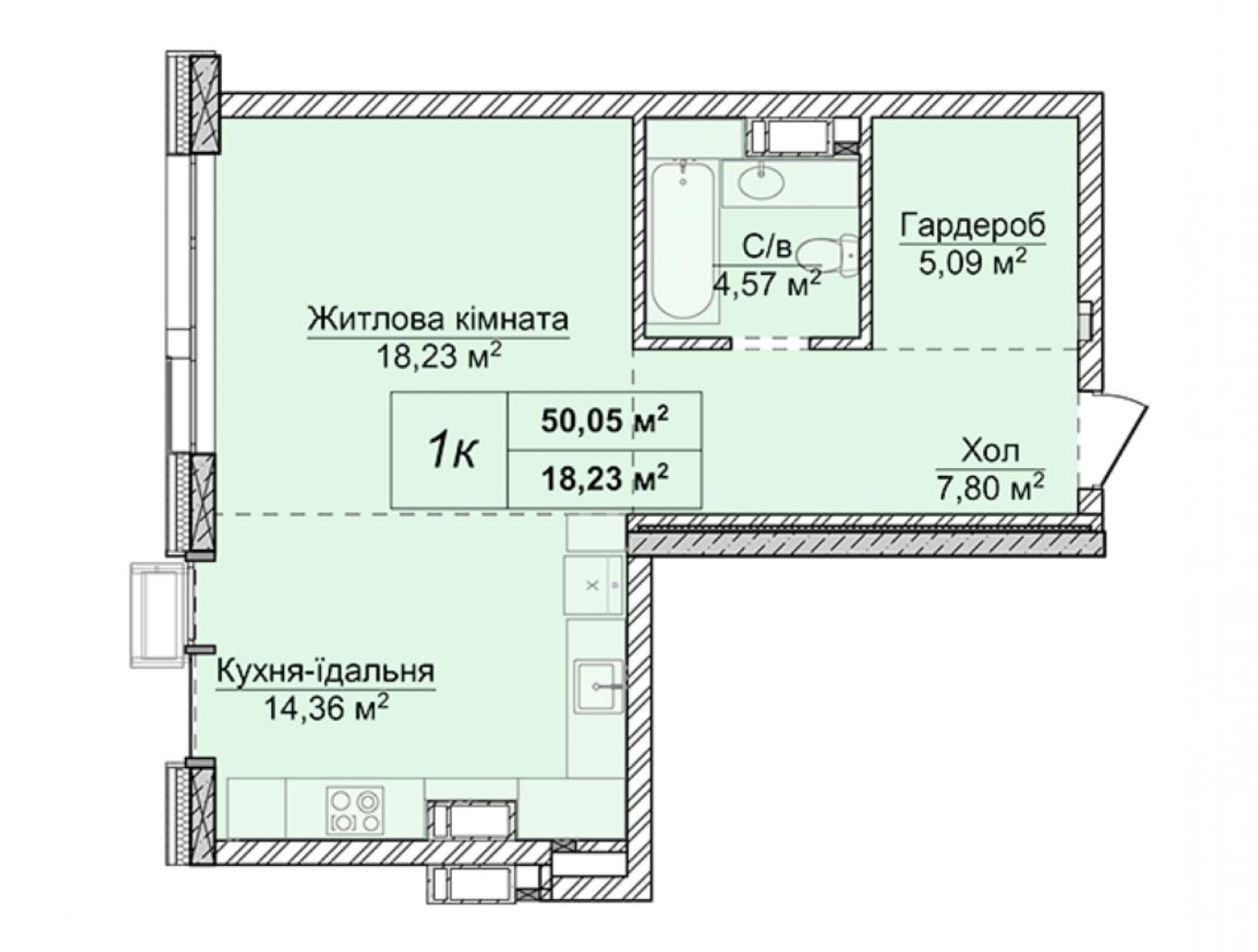
For example, if an apartment has a bedroom (14 m²), a living room (18 m²), a kitchen (10 m²), a hallway (6 m²), and a bathroom (4 m²), the living area would be 32 m², because only the bedroom and living room are included in the calculation.
What is not considered living space
Not all rooms in an apartment or house are considered living space. Even if they are used actively every day, they may be classified as auxiliary or common areas. The following are not considered living space:
kitchen;
bathroom, toilet;
hallway, entryway, pantry, walk-in closet;
balcony, loggia, terrace, veranda;
boiler rooms, basements, garages, and attics that are not classified as residential spaces.
It is worth noting two common misconceptions. First, even after insulation and renovation, balconies and loggias are listed separately in technical documentation and are not considered living space.
The second misconception concerns the kitchen-living room—a common layout in modern apartments. If the room is officially designated as a kitchen in the documents, it is not included in the living area, even if it contains a sofa and a seating area. However, if the kitchen and living room are combined during a renovation and officially reclassified as a living room, then such a space can be included in the living area. The key reference point is always the technical passport.
How does living space differ from total floor area
Living area and total area are two different metrics used in real estate documents. Living area includes only the rooms used for living, while total area includes virtually all the rooms inside an apartment or house.
The total area typically includes living rooms, the kitchen, hallways, bathrooms, storage rooms, built-in closets, entryways, and interior staircases. Balconies, loggias, and terraces may be calculated separately or included with a reduction factor, depending on the calculation rules and the type of documentation.
The main difference can be summarized as follows: living area indicates how much space is specifically designated for living, whereas total area indicates the size of the entire property. For example, an apartment’s living area is 42 m², and its total area is 68 m². This means that 42 m² is occupied by living rooms, while the remaining 26 m² is accounted for by the kitchen, hallway, bathroom, and other auxiliary rooms.
The difference between these metrics is important for several reasons:
Housing costs are often calculated based on total square footage;
housing standards and certain social calculations may take living space into account;
When renovating, it is important to understand the status of each room;
Banks and government agencies use both metrics in their documents.
Before buying a property, you should carefully check the exact square footage listed in the ad. Sometimes sellers focus only on the total square footage, even though there may actually be few living rooms.
How to determine the living area of an apartment or house
The most reliable way to determine the living area is to check the property’s technical documentation. It officially specifies which rooms are considered living spaces and which are classified as auxiliary spaces.
The main documents where you can find this information:
technical specifications;
an extract from the real estate registry;
sales contract;
project documentation;
BTI documents.
The technical specifications typically list the total area, the living area, and the area of each room separately. This makes it easy to see how many square meters are actually allocated to living spaces.
If you don’t have the documents on hand, you can calculate the living area yourself. To do this, add up the square footage of all the living rooms. For example, the bedroom is 15 m², the children’s room is 12 m², and the living room is 20 m². The living area will be 47 m². When calculating on your own, it is important not to include the kitchen, bathroom, hallway, storage room, balcony, or loggia.
It is also important to note that if the apartment has been remodeled and the changes have not been officially registered, the information in the technical passport is considered legally valid, not the actual layout. To change the status of a room—for example, to combine the kitchen and living room into a single living space—you must formally update the documents with the BTI or the relevant government agencies.
Before buying an apartment or a house, it is advisable to:
compare the actual layout with the documents;
check for any unauthorized renovations;
clarify which premises are officially considered residential;
Note the difference between total floor area and living area.
This will help you avoid problems when finalizing a transaction, selling property in the future, or applying for a loan.
How many square meters of living space are allocated per person in Ukraine
Ukraine has established living space standards per person, which are used to calculate social standards, register individuals on the housing waiting list, process benefits, and administer certain government programs. These space standards may also be relevant when providing temporary housing, registering residents in dormitories, and determining whether a dwelling is overcrowded.
Currently, the standard for housing is 13.65 square meters of living space per person, plus an additional 35.22 square meters of total floor area per household. These figures are used to calculate subsidies and determine eligibility for improved housing conditions.
In some cases, different standards may apply depending on the type of housing, the number of family members, local programs, the individual’s status, and the conditions for providing social housing. For example, when registering applicants for housing, local authorities may take into account the level of living space available. If the living space per person is less than the established standard, the family may be eligible for improved housing conditions. It is important to understand that this usually refers specifically to living space, not total floor area.
For example, a family of three lives in an apartment with a living area of 30 m². This amounts to 10 m² per person—which is below the social standard. This means the family is eligible for improved housing conditions.
Since laws and social standards are subject to change, it is advisable to verify the current regulations with local government authorities, the Administrative Services Center (ASC), or the relevant government agencies before submitting your documents.